0
1
0
1
torch.linalg.lstsq无法加速
2025-09-02 18:15:24
130
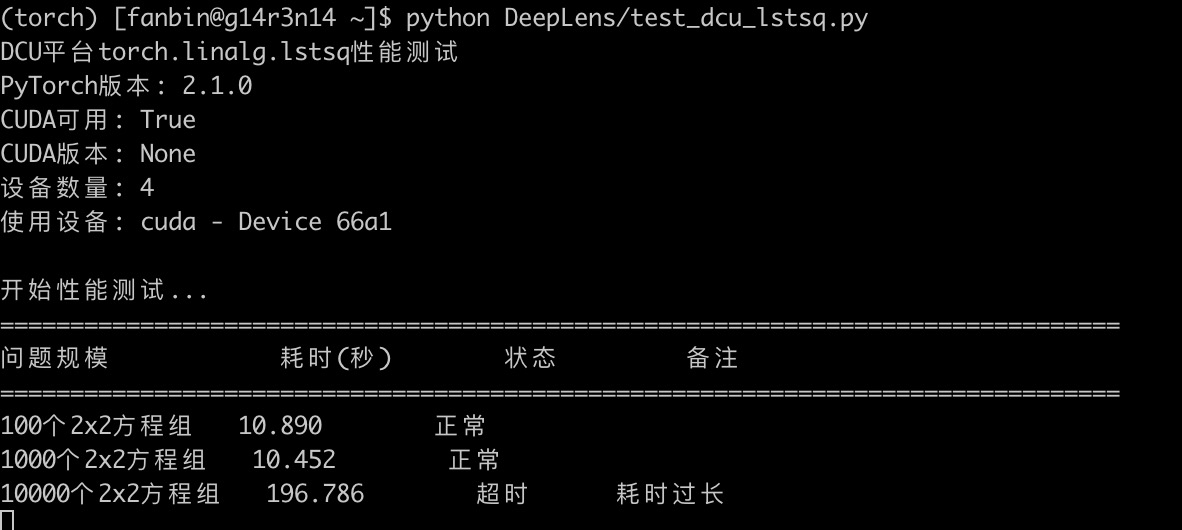
调用torch.linalg.lstsq函数时会卡死,于是作了对比。
加载的pytorch版本是pytorch-2.1.0-dtk2310,
在本地cuda环境速度不过几毫秒,而在DCU上却要好几个小时。
--
楼主

0 点赞
0 帖子
楼主热帖
 暂无数据
常见问题新帖
暂无数据调用torch.linalg.lstsq函数时会卡死,于是作了对比。
加载的pytorch版本是pytorch-2.1.0-dtk2310,
在本地cuda环境速度不过几毫秒,而在DCU上却要好几个小时。
暂无数据 暂无数据
测试代码如下:
import torch
import time
import numpy as np
import sys
def test_lstsq_performance():
if torch.cuda.is_available():
device = torch.device("cuda")
device_name = torch.cuda.get_device_name(0)
print(f"使用设备: {device} - {device_name}")
else:
device = torch.device("cpu")
print(f"使用设备: {device}")
# 测试不同的问题规模
test_sizes = [
(100, 2, 2), # 小规模:100个2x2线性方程组
(1000, 2, 2), # 中规模:1000个2x2线性方程组
(10000, 2, 2), # 大规模:1万个2x2线性方程组
(50000, 2, 2), # 超大规模:5万个2x2线性方程组
(100000, 2, 2), # 极大规模:10万个2x2线性方程组(接近实际问题规模)
]
print("\n开始性能测试...")
print("="*80)
print(f"{'问题规模':<15} {'耗时(秒)':<12} {'状态':<10} {'备注'}")
print("="*80)
for n_equations, m, n in test_sizes:
try:
print(f"{n_equations}个{m}x{n}方程组", end="")
# 创建随机测试数据
A = torch.randn(n_equations, m, n, device=device, dtype=torch.float32)
b = torch.randn(n_equations, m, 1, device=device, dtype=torch.float32)
# 预热GPU
if device.type == 'cuda':
torch.cuda.synchronize()
# 开始计时
start_time = time.time()
# 设置超时检测
max_wait_time = 30.0 # 最多等待30秒
# 执行求解
try:
if device.type == 'cuda':
torch.cuda.synchronize()
x, residuals = torch.linalg.lstsq(A, b)[:2]
if device.type == 'cuda':
torch.cuda.synchronize()
end_time = time.time()
elapsed = end_time - start_time
if elapsed > max_wait_time:
print(f" {elapsed:.3f} 超时 耗时过长")
else:
print(f" {elapsed:.3f} 正常 ")
except Exception as e:
end_time = time.time()
elapsed = end_time - start_time
print(f" {elapsed:.3f} 错误 {str(e)[:30]}...")
except KeyboardInterrupt:
print(" 中断 手动停止 用户中断")
break
except Exception as e:
print(f" 失败 异常 {str(e)[:30]}...")
print("="*80)
def main():
print("DCU平台torch.linalg.lstsq性能测试")
print(f"PyTorch版本: {torch.__version__}")
print(f"CUDA可用: {torch.cuda.is_available()}")
if torch.cuda.is_available():
print(f"CUDA版本: {torch.version.cuda}")
print(f"设备数量: {torch.cuda.device_count()}")
# 基本性能测试
test_lstsq_performance()
if __name__ == "__main__":
main()